ServicesDental Implants
Dental Implants in Prosper, TX
Lost a tooth? An implant gives you a new root and a new tooth that bites and looks natural. First we figure out why the tooth failed by checking bone, gums and bite. Then the implant goes where it can hold for the long run.
How implants work and who they help
Think of an implant in layers. A small titanium post sits in the jaw where the old root was. On it goes a short connector, the abutment. The crown, bridge or denture fastens to that. In the months after placement, bone fuses to the post, and that fusion is why you can chew a steak or a crisp apple without worry.
Plenty of adults are good candidates, whether they are missing one tooth, a few or a full arch. Still, an implant is not always where we start. A cracked tooth might be saved with a root canal. Gum disease might need care first. Putting a post into soft bone or infected gums is how implants fail, so we sort those problems out ahead of time.
So we examine before we plan. People visit us from Prosper, McKinney, Little Elm and the surrounding area, and most finish that first appointment understanding what caused the problem and which choices make sense.
What we handle during implant treatment
The $25 evaluation
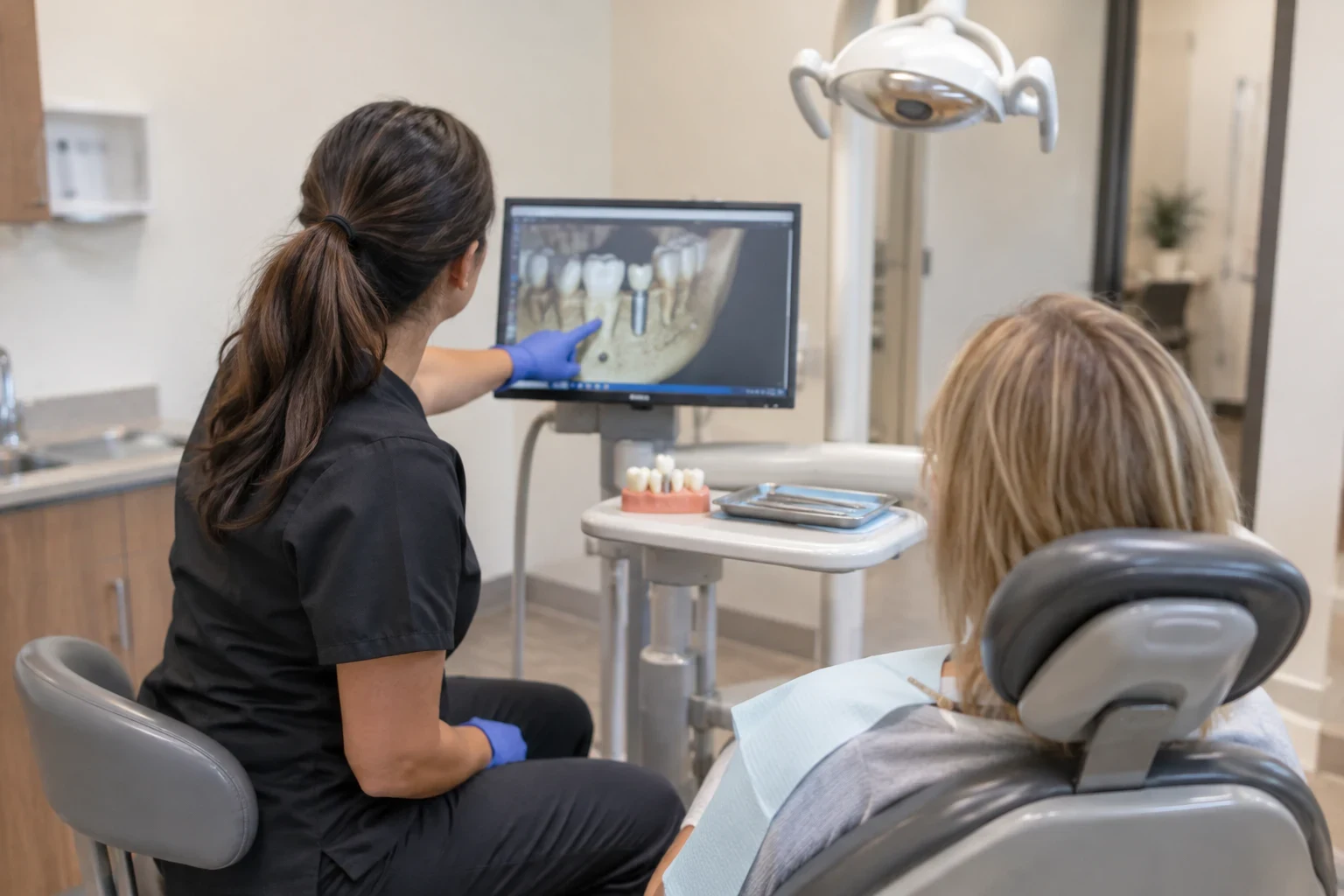
This visit covers a full exam and digital X-rays. If your case calls for it, we add a CBCT scan, then we build your treatment plan and talk it over with you. The CBCT is a 3D picture that shows the height and width of your bone and where the nerves run.
Your plan in writing
Every step is laid out in order, with what it is for and what it costs. If you need a graft or a removal, you see it on paper before you agree to anything.
Removing a failing tooth
If the bad tooth is still in place, we take it out gently and protect the socket so the bone stays strong enough for an implant later. Sometimes the post can go in the same day.
Rebuilding bone
The jaw starts to shrink after a tooth has been gone a while. A graft puts back enough bone to wrap around the post.
Placing the post
We numb the area so you stay comfortable while the post goes in. Most patients describe it as firm pressure.
The finished tooth
After healing, you get a crown matched to the shade of your smile, or a bridge or denture fastened to several implants. We adjust the bite so the implant does not take too much force.
When an implant is worth a look
You only chew on one side
Favoring one side wears those teeth harder. Over time the teeth next to the gap can drift or lean into it.
Your denture rocks or slides
If you rely on lots of adhesive, the bone under the denture has probably shrunk. A couple of implants can lock it in place.
The tooth is past saving
A crack that runs under the gum or decay that goes too deep can leave nothing to fix. We confirm it on X-rays before we talk about removal.
An old bridge keeps breaking down
Decay under a bridge harms the teeth anchoring it. Implants carry the bite on their own and spare those teeth.
Your cheeks look sunken
Losing back teeth lets the lips and cheeks fall in a little. Implants help hold the bone and the shape of your face.
How the process goes, step by step
- 1
Exam and 3D scan
We look at the whole mouth, not just the gap. X-rays and a CBCT scan if needed show us the bone, the sinus and nerve positions, and any infection that has to be dealt with first.
- 2
Talk through the plan
We sit down and go over what we found, using your own images. You hear your options, including ones that are not implants, and what each costs. There is no pressure to decide that day.
- 3
Placement visit
We numb the area, place the post and close the gum. Most people go back to work the next day. We send you home with clear care instructions and a soft food list.
- 4
Healing time
The bone bonds to the post over the following months. You may wear a temporary tooth so there is no visible gap. We check in to make sure it is healing well.
- 5
Final tooth
We take impressions, attach the abutment and fit your crown, bridge or denture. Then we adjust the bite until it feels right.
What changes the price of an implant
No two implant cases are built the same, so a number given before an exam is only a guess. Once we have your X-rays and scan, you get a written plan with a price next to every step. If you want to spread the cost out, ask about 0% interest financing for up to 24 months. Checking whether you preapprove does not affect your credit score.
- Number of missing teeth
- One post with one crown is the simplest case. Replacing several teeth or a full arch takes more posts and a larger restoration on top.
- Condition of bone and gums
- A thin jaw may need grafting before the post goes in. Gum disease has to be treated first. Each adds a step, and each helps the implant last.
- A tooth still in the way
- Removing a damaged tooth adds a visit. In some mouths the post can go in right after the removal, which saves you a trip.
- What goes on top
- A single crown, a bridge across two posts and a denture that snaps onto implants each take different time and materials.
- Insurance or no insurance
- Our office is an in-network provider for more than 15 major PPO dental plans, but each plan treats implants its own way. If you have no dental insurance, our In-house Membership Plan for uninsured patients can lower what you pay.
Common implant questions
Something not covered here? (972) 823-9036
Is implant placement painful?
We numb the area completely before we start. Patients usually notice pressure and some vibration, not sharp pain. You may be sore for a couple of days after. Store-bought pain relievers and soft meals are enough for most people.
How long from start to finish?
Plan on a few months between placing the post and fitting the final tooth. The bone needs that time to fuse with the post. Grafting or a removal beforehand can stretch it out. Your written plan shows the full timeline up front.
Can older adults get implants?
Yes, in many cases. Age alone seldom rules anyone out. What matters more is how much bone you have, how healthy your gums are and certain medical conditions. The exam and scan answer that.
Does insurance cover implants?
That depends on the plan. Some PPO plans pay toward the post or the crown, and some pay very little. We look up your benefits and show your share in writing before any treatment begins.
What happens if an implant is not right for me?
We tell you plainly and show you why on your images. Sometimes a graft solves it. Other times a bridge or a denture serves you better. Either way you hear every honest option.
How do I take care of an implant?
Clean it the way you clean your other teeth, with brushing and flossing, and keep up your cleanings. The implant itself cannot decay. The gum around it can still get infected if plaque is left there.

See if your jaw is ready for an implant
Book a $25 focused evaluation and we will take X-rays, plus a 3D scan if it is needed. You walk out with a clear answer about the cause and the steps to replace the tooth.